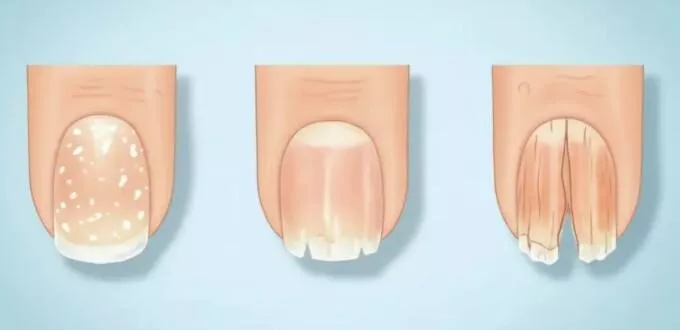
Congenital or acquired origin (trauma, infections, systemic diseases).
Treatment is a medical procedure: always consult specialised practitioners.
Acting early prevents complications and recurrences.
Nail disorders
Onychopathies (nail disorders) include all the conditions of the nail plate that compromise its integrity, altering its shape, structure and function.
They may be congenital or acquired and can develop as a result of trauma, an infection or a systemic disease.
When the nail plate is affected by a disorder, it loses its natural protective function, leading to pain, functional impairment and possible complications.
Acting early is essential: a treatment carried out improperly or by non-medical personnel can worsen the condition, encourage infections and make full resolution more difficult.
Through a specialist assessment, the podiatrist identifies the cause of the problem and sets up the most appropriate treatment, with the aim of eliminating pain, restoring the nail’s health and preventing recurrences.
The main nail disorders
The main nail disorders within the podiatrist’s remit include:
Clinical case
Onychocryptosis (lateral ingrown toenail)The nail grows into the nail fold, causing pain, inflammation and, in more advanced cases, infection.
Clinical case
Retronychia (posterior ingrown toenail)The nail plate ingrows posteriorly, towards the base of the toe, following trauma, causing persistent inflammation and difficulty in the nail’s normal regrowth.
Clinical case
OnychomycosisA fungal infection of the nail that alters its colour, thickness and texture, making it progressively more fragile and deformed.
Clinical case
OnycholysisDetachment of the nail plate from the nail bed, of traumatic origin, often confused with onychomycosis and consequently treated as such without success.
Pincer nailA deformity in which the nail plate curves transversely, tightening towards the sides until it compresses the nail bed. It causes pain and can encourage the onset of an ingrown toenail.
Clinical case
OnychophosisA build-up of keratinous tissue in the nail fold that causes pain and can encourage the onset of an ingrown toenail.
Clinical case
OnychogryphosisMarked thickening and deformity of the nail, often associated with age, repeated trauma or growth disturbances.
Clinical case
OnychomadesisComplete detachment of the nail plate resulting from trauma or temporary disturbances in its growth.
Subungual haematomaA collection of blood under the nail caused by trauma, often accompanied by intense pain.
Clinical case
Subungual friction granulomaInflammatory granulation tissue that develops following repeated trauma or friction to the nail. It appears as a small reddish mass, prone to bleeding and painful, near the nail fold.
Clinical case
Green nail syndromeA greenish-black discolouration of the nail plate caused by a bacterial infection, often encouraged by onycholysis and persistent moisture.
Clinical case
Subungual tylomaA painful keratotic thickening that develops under the nail plate, generally caused by repeated microtrauma or excessive local pressure.
Specialist training makes the difference
The most complex nail disorders — such as chronic recurrent onychocryptosis, retronychia and onychomycosis — require specific skills that go beyond the podiatrist’s basic university training.
Attending University Master’s programmes dedicated to Nail Disorders and advanced training courses makes it possible to gain advanced knowledge in the diagnosis and treatment of the most complex cases, offering the patient an up-to-date, personalised treatment pathway based on the most recent scientific evidence.
In particular, in the treatment of chronic recurrent onychocryptosis (chronic ingrown toenail), specific training in Chemical Cauterisation of the Nail Matrix — gained through a University Advanced Training Course — represents an advanced skill that makes it possible, in suitable cases, to resolve the condition permanently.
The treatment of nail disorders is a medical procedure and must be carried out exclusively by specialised practitioners, in a suitably equipped clinic and in compliance with the strictest safety and sterility standards.
Frequently asked questions
What are onychopathies?
They are disorders of the nail plate that alter its shape, structure and function. They may be congenital or acquired (trauma, infections, systemic diseases) and should be treated by the podiatrist.
Can I treat an ingrown toenail on my own?
No: the treatment of nail disorders is a medical procedure. An improper intervention can worsen the problem and encourage infections. The podiatrist identifies the cause and sets up the correct treatment.
Can a chronic ingrown toenail and a pincer nail be resolved permanently?
Yes, in suitable cases. Chemical cauterisation of the nail matrix makes it possible to permanently resolve both recurrent onychocryptosis (chronic ingrown toenail) and pincer nail.
Content byDr. Romina OrsettiPodiatrist · First-level Master’s in Nail Disorders · over 30 years’ experience in foot care · Osimo and Villa Musone di Loreto (AN)
A problem with your nails? Book an assessment
Book an assessment in Osimo or Villa Musone di Loreto: prevention is better than cure.